Decibel Shield
Decibel chart › Gas-powered leaf blower
How loud is a gas-powered leaf blower?
A gas-powered leaf blower measures 92–102 dB, roughly as loud as a hand drill. At 102 dB it is at or above the 85 dB line where hearing damage starts: NIOSH puts the safe limit at about 9 minutes a day. Normal conversation runs about 60 dB for comparison.
Last updated:
| Decibel level | 92–102 dB |
|---|---|
| Hearing risk | High risk — NIOSH, 2025, measured on the worker while the blower ran: 96.9 dBA on average over 157 tasks, typically 92 to 102 (one standard deviation either side), highest 105.9 |
| Safe exposure (NIOSH) | About 9 minutes a day |
| Typical setting | work |
Figures sourced to CDC / NIOSH. See the full decibel levels chart for every source.
Measured on the worker, at the operator's ear. For the level farther away, such as 50 ft from a window, the sound distance calculator gives an open-air estimate.
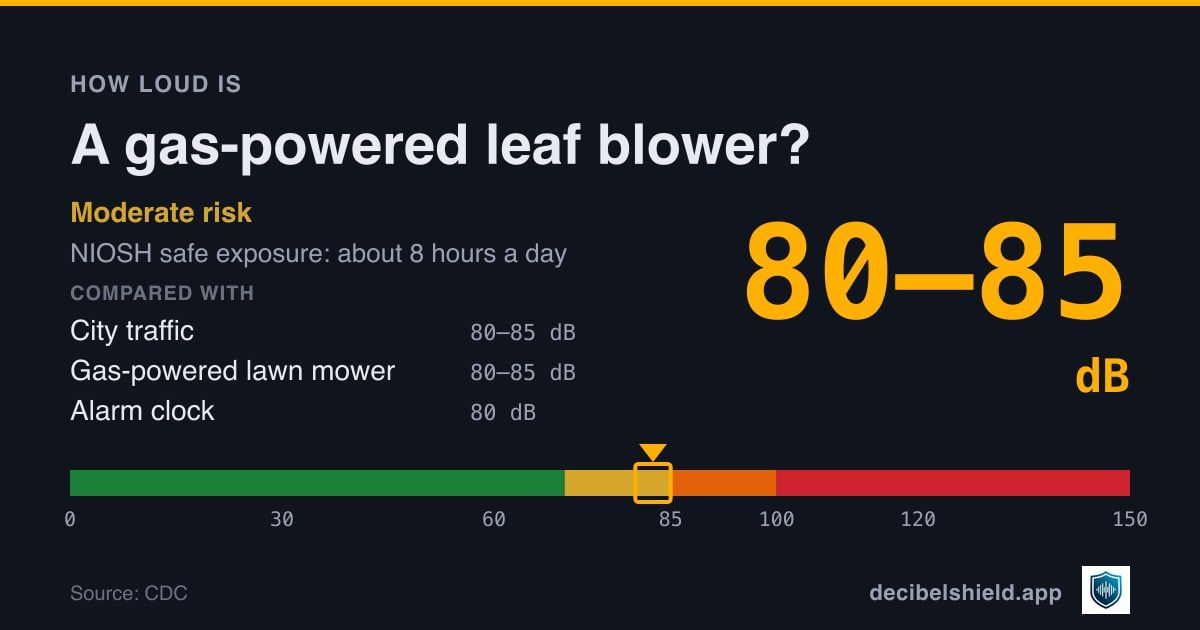
How a gas-powered leaf blower compares
On the decibel scale, 92–102 dB sits above the 85 dB line where sustained exposure damages hearing. Sounds at a similar level:
- Hand drill 98 dB
- Stock car race 96 dB
- Motorcycle 95 dB
- Cicada chorus 90–100 dB
Everything at this level, with safe exposure times: how loud is 97 dB? → Nearby: 92 dB · 101 dB
How loud is a gas-powered leaf blower?
A gas-powered leaf blower measures 92–102 dB, roughly as loud as a hand drill. At 102 dB it is at or above the 85 dB line where hearing damage starts: NIOSH puts the safe limit at about 9 minutes a day. Normal conversation runs about 60 dB for comparison.
Is a gas-powered leaf blower dangerous to hearing?
Yes — at 102 dB, a gas-powered leaf blower is loud enough to damage hearing over time. NIOSH limits safe exposure to about 9 minutes a day; use hearing protection beyond that.
Measure it yourself
Decibel levels vary with distance and surroundings. Check the real level where you are with the free online decibel meter — no install, nothing recorded — or see the full decibel levels chart.