 Decibel Shield
European cities › Sweden › Stockholm
How loud is Stockholm, Sweden?
In Stockholm, Sweden, most noise-exposed residents face average day-evening-night (Lden) transport noise of 50–70 dB, mostly from road traffic, dropping to 50–65 dB at night. That ranks Stockholm #259 of 314 European cities by modeled EEA exposure, below the European median — quieter than most cities in the ranking.
Last updated:
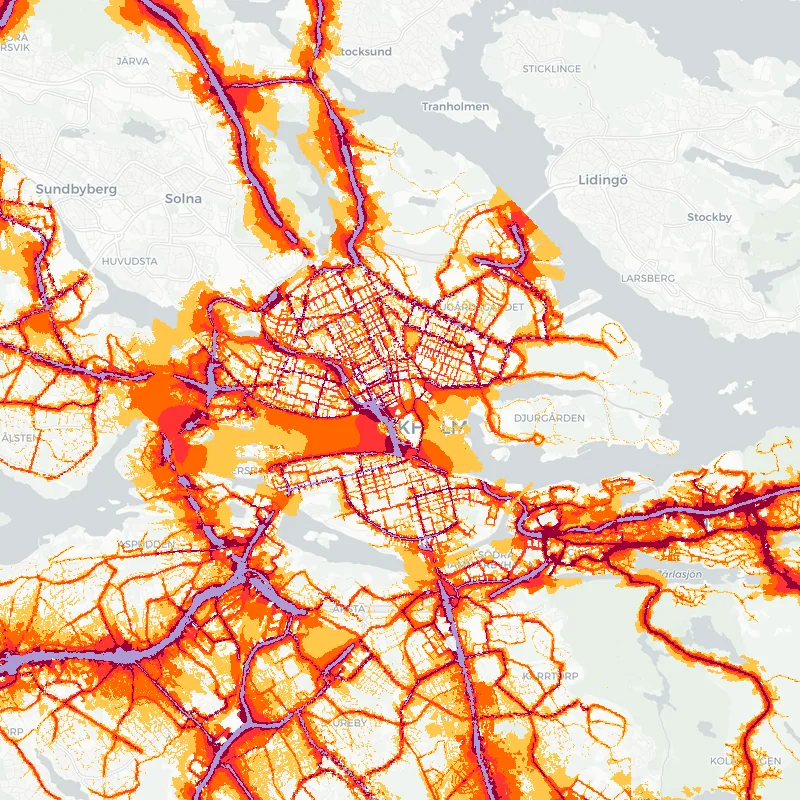
| European rank (of 314) | #259 |
|---|---|
| Daytime Lden range | 50–70 dB |
| Night Lnight range | 50–65 dB |
| vs. WHO guideline | ≈ 7 dB above the 53 dB Lden road-noise guideline (night guideline: 45 dB) |
| Dominant source | road traffic |
| Population | 974,073 |
| Data confidence | high |
With 974,073 residents, Stockholm reports day-evening-night transport noise of 50–70 dB for its exposed population (50–65 dB at night), mostly from road traffic. That is #259 of 314 European cities, below the European median — quieter than most cities in the ranking. Among Sweden's 18 ranked agglomerations, Stockholm is the 13th-loudest. Across Europe it sits just below Padua, Italy (#258) and just above Kauniainen, Finland (#260).
The WHO road-traffic guideline is 53 dB Lden by day and 45 dB Lnight at night, so Stockholm's exposed residents run roughly 7 dB above the daytime guideline. The figures count road, rail, aircraft and industry only, so sirens, nightlife and construction sit outside the model — which is why modeled exposure can differ from a city's reputation for noise.
These are the agency's modeled values, not our estimates: they come from Sweden's strategic noise maps reported under the EU Environmental Noise Directive (2022 round) and harmonised by the European Environment Agency. Lden is the annual-average day-evening-night level; only people above the 55 dB Lden reporting threshold are counted, so the range describes the noise-exposed population, not the city's quietest streets.
Environmental noise in Stockholm, by the numbers
- Ranks #259 of 314 European cities by modeled day-evening-night (Lden) transport-noise exposure.
- Exposed residents face Lden 50–70 dB by day and Lnight 50–65 dB at night.
- Dominant noise source: road traffic. Population 974,073.
- The 13th-loudest of Sweden's 18 ranked agglomerations.
These are modeled values from the EU Environmental Noise Directive strategic noise maps (2022 round), harmonised by the European Environment Agency — see the methodology on the European city ranking. Lden is the annual-average day-evening-night level; only residents above the 55 dB Lden threshold are reported.
License: Stockholm's figures and noise map are published under CC BY 4.0 — reuse or republish with attribution to decibelshield.app (source: EU Environmental Noise Directive strategic noise maps, 2022 round, European Environment Agency; basemap © OpenStreetMap contributors, © CARTO). Download the full dataset (CSV · JSON) or the Stockholm map image.
How Stockholm ranks
- #13 of 18 Sweden cities in-country
- Louder: Padua, Italy #258
- Quieter: Kauniainen, Finland #260
Cities near Stockholm
The nearest mapped cities to Stockholm, each with its own daytime range from the same official noise maps for a like-for-like comparison.
- Nacka, Sweden 50–70 dB · 6 km
- Huddinge, Sweden 55–70 dB · 11 km
- Uppsala, Sweden 55–70 dB · 64 km
- Eskilstuna, Sweden 50–65 dB · 89 km
Measure your own street
Standing somewhere loud in Stockholm right now? Measure it with the free online decibel meter → No install, nothing recorded.