 Decibel Shield
European cities › Germany › Bergisch Gladbach
How loud is Bergisch Gladbach, Germany?
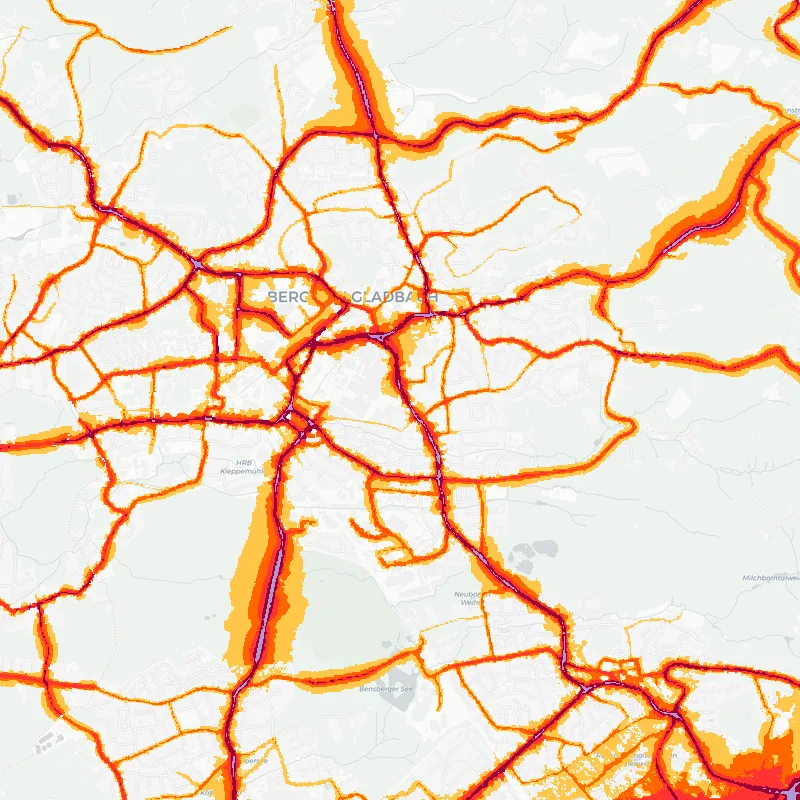
In Bergisch Gladbach, Germany, most noise-exposed residents face average day-evening-night (Lden) transport noise of 55–70 dB, mostly from road traffic, dropping to 50–65 dB at night. That ranks Bergisch Gladbach #81 of 314 European cities by modeled EEA exposure, right at the European median.
Last updated:
| European rank (of 314) | #81 |
|---|---|
| Daytime Lden range | 55–70 dB |
| Night Lnight range | 50–65 dB |
| vs. WHO guideline | ≈ 10 dB above the 53 dB Lden road-noise guideline (night guideline: 45 dB) |
| Dominant source | road traffic |
| Population | 111,600 |
| Data confidence | high |
Bergisch Gladbach houses 111,600 people. Its noise-exposed residents experience Lden levels of 55–70 dB by day and 50–65 dB at night, driven mainly by road traffic, which puts it #81 of 314 in the European ranking — right at the European median. Among Germany's 72 ranked agglomerations, Bergisch Gladbach is the 42nd-loudest. Across Europe it sits just below Leuven, Belgium (#80) and just above Erlangen, Germany (#82).
The WHO road-traffic guideline is 53 dB Lden by day and 45 dB Lnight at night, so Bergisch Gladbach's exposed residents run roughly 10 dB above the daytime guideline. The figures count road, rail, aircraft and industry only, so sirens, nightlife and construction sit outside the model — which is why modeled exposure can differ from a city's reputation for noise.
These are the agency's modeled values, not our estimates: they come from Germany's strategic noise maps reported under the EU Environmental Noise Directive (2022 round) and harmonised by the European Environment Agency. Lden is the annual-average day-evening-night level; only people above the 55 dB Lden reporting threshold are counted, so the range describes the noise-exposed population, not the city's quietest streets.
Environmental noise in Bergisch Gladbach, by the numbers
- Ranks #81 of 314 European cities by modeled day-evening-night (Lden) transport-noise exposure.
- Exposed residents face Lden 55–70 dB by day and Lnight 50–65 dB at night.
- Dominant noise source: road traffic. Population 111,600.
- The 42nd-loudest of Germany's 72 ranked agglomerations.
These are modeled values from the EU Environmental Noise Directive strategic noise maps (2022 round), harmonised by the European Environment Agency — see the methodology on the European city ranking. Lden is the annual-average day-evening-night level; only residents above the 55 dB Lden threshold are reported.
License: Bergisch Gladbach's figures and noise map are published under CC BY 4.0 — reuse or republish with attribution to decibelshield.app (source: EU Environmental Noise Directive strategic noise maps, 2022 round, European Environment Agency; basemap © OpenStreetMap contributors, © CARTO). Download the full dataset (CSV · JSON) or the Bergisch Gladbach map image.
How Bergisch Gladbach ranks
- #42 of 72 Germany cities in-country
- Louder: Leuven, Belgium #80
- Quieter: Erlangen, Germany #82
Cities near Bergisch Gladbach
The nearest mapped cities to Bergisch Gladbach, each with its own daytime range from the same official noise maps for a like-for-like comparison.
- Leverkusen, Germany 55–70 dB · 12 km
- Cologne, Germany 55–75 dB · 14 km
- Solingen, Germany 55–75 dB · 21 km
- Remscheid, Germany 55–75 dB · 22 km
Measure your own street
Standing somewhere loud in Bergisch Gladbach right now? Measure it with the free online decibel meter → No install, nothing recorded.