 Decibel Shield
UK cities › England › Middlesbrough
How loud is Middlesbrough?
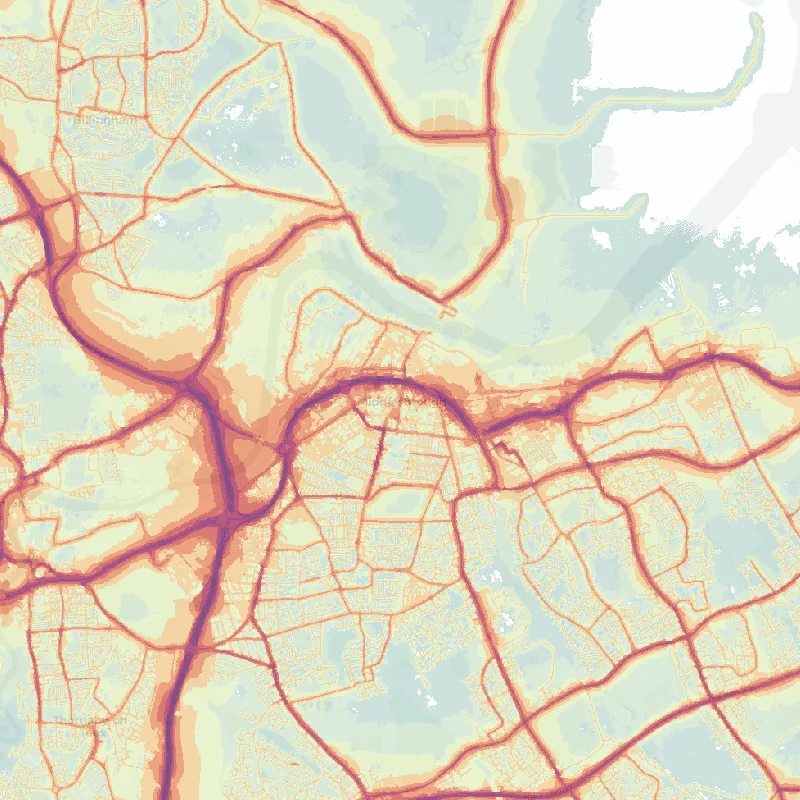
Ranked by the average noise level among the residents who are exposed, Middlesbrough is #53 of 65 English urban areas in the government's strategic noise mapping, placing it among the quietest quarter of that list. In Middlesbrough, most noise-exposed residents face average day-evening-night (Lden) transport noise of 55–70 dB, mostly from road traffic, dropping to 50–60 dB at night.
Last updated:
| England rank (of 65) | #53 |
|---|---|
| Daytime Lden range | 55–70 dB |
| Night Lnight range | 50–60 dB |
| vs. WHO guideline | ≈ 10 dB above the 53 dB Lden road-noise guideline (night guideline: 45 dB) |
| Dominant source | road traffic |
| Mapped area | Teesside (England) |
| Population | 369,000 |
| Data round | Round 3 (2017) |
The numbers here are the government's own exposure statistics for Middlesbrough, produced under the UK's environmental noise regulations. The figures cover the official "Teesside" agglomeration, the statutory noise-mapping area, which is wider than the city centre alone.
Across the 369,000 residents of the mapped area, the bulk of those exposed to transport noise sit in the 55–70 dB Lden band by day-evening-night average and 50–60 dB Lnight at night, with road traffic the dominant source. The midpoint of that daytime range is roughly 10 dB above the WHO's 53 dB Lden road-noise guideline (the night guideline is 45 dB Lnight).
These statistics come from the Round 3 strategic noise mapping (2017, the latest England exposure statistics published). Defra publishes these exposure statistics as counts of people per dB band rather than one number per place, and most English urban areas share the same broad daytime band. The ranking therefore comes from the population-weighted average level across those bands among the exposed residents, which separates areas that the band alone cannot. Defra's Round 4 maps (2022) exist as noise-level grids, but the matching population-exposure tables are due to be published with the next Noise Action Plans — this page will be updated to Round 4 when they land.
Environmental noise in Middlesbrough, by the numbers
- England rank: #53 of 65 mapped urban areas (loudest = #1)
- Daytime (Lden) exposure band: 55–70 dB for the bulk of exposed residents
- Night (Lnight) exposure band: 50–60 dB
- Dominant noise source: road traffic
- Mapped-area population: 369,000
- Data: Round 3 (2017), England strategic noise mapping
These are the official published exposure statistics from the UK's strategic noise mapping — see the methodology on the UK city ranking. Lden is the annual-average day-evening-night level; only residents above the 55 dB Lden threshold are reported.
License: Middlesbrough's derived figures and noise map are published under CC BY 4.0 — reuse or republish with attribution to decibelshield.app. Contains public sector information from Defra, the Scottish Government, the Welsh Government and DAERA, licensed under the Open Government Licence v3.0. Basemap © OpenStreetMap contributors, © CARTO. Download the full dataset (CSV · JSON) or the Middlesbrough map image.
How Middlesbrough ranks
- #53 of 65 ranked England cities in-nation
- Louder: Southampton #52
- Quieter: Aldershot #54
Cities near Middlesbrough
The nearest mapped cities to Middlesbrough, each with its own daytime range from the same strategic noise mapping for a like-for-like comparison.
- Sunderland 55–75 dB · 38 km
- Newcastle upon Tyne 55–75 dB · 50 km
- York 55–75 dB · 69 km
- Leeds 55–75 dB · 89 km
Measure your own street
Standing somewhere loud in Middlesbrough right now? Measure it with the free online decibel meter → No install, nothing recorded.