 Decibel Shield
US cities › New York › Upper West Side (Central)
Upper West Side (Central) noise map: how loud is it?
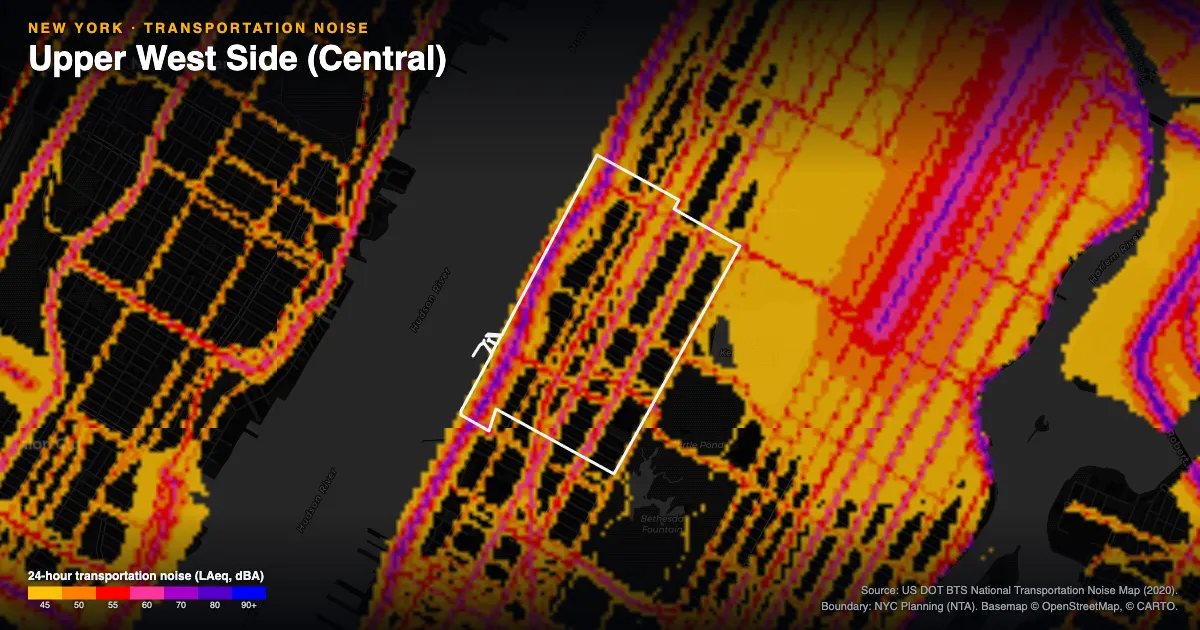
Upper West Side (Central) sits in the middle of New York's noise range: 9.6% of residents face 60 dB or louder average-day transportation noise — road, rail and aviation combined — ranking it 50th of 197 New York neighborhoods. Zoom the map below to see which blocks run loud and which stay calm.
Last updated:
| Rank in New York (of 197 neighborhoods) | #50 |
|---|---|
| Residents above 60 dB | 9.6% |
| Residents above 70 dB | 1.1% |
| Residents in the 45–60 dB band | 49.1% |
| Residents (ACS 2016–2020, area-weighted) | 73,707 |
| Census tracts mapped | 15 |
Upper West Side (Central) is home to about 73,707 residents across 15 census tracts. 9.6% of them are exposed to 60 dB or more of average-day road, rail and aviation noise. Within that, 1.1% face the most severe band — 70 dB or louder, the level at which sustained exposure starts to threaten hearing. A further 49.1% sit in the 45–60 dB band — a noticeable background hum rather than a hearing risk. That ranks Upper West Side (Central) #50 of 197 New York neighborhoods, louder than most New York neighborhoods. Among New York neighborhoods it sits just below Mount Eden-Claremont (West) (#49) and just above Brooklyn Heights (#51).
Exposure across Upper West Side (Central) is a patchwork. The streets that back onto a freeway, rail line or flight path carry most of the 9.6%, while interior blocks a few hundred feet away can sit 15 to 25 dB quieter. The map makes that split easy to see.
Upper West Side (Central) noise: the specifics
- Ranks #50 of 197 New York neighborhoods by share of residents exposed to ≥60 dB transportation noise.
- 9.6% of Upper West Side (Central)'s ~73,707 residents live with 60 dB or louder average-day transportation noise.
- 1.1% are in the severe 70 dB+ band; 49.1% sit in the 45–60 dB moderate range.
- Area-weighted across 15 census tracts from the federal BTS 2020 noise map × ACS 2016–2020 population.
- #50 of 197 — see the full New York ranking.
What share of Upper West Side (Central) residents are exposed to 60 dB or louder transportation noise?
9.6% of Upper West Side (Central) residents live with average-day transportation noise (road, rail and aviation) at or above 60 dB, and 1.1% are above 70 dB — ranking Upper West Side (Central) #50 of 197 New York neighborhoods by noise exposure.
How Upper West Side (Central) compares
- Louder: Mount Eden-Claremont (West) #49
- Quieter: Brooklyn Heights #51
- All New York neighborhoods 197
How this is calculated
This is a transparent aggregation of federal data, not an estimate: the US DOT 2020 National Transportation Noise Map (road + rail + aviation), paired with Census population by the University of Washington and area-weighted to the New York Times boundary for Upper West Side (Central). It does not count sirens, construction, nightlife or neighbors, and it resolves busy corridors better than quiet local streets. BTS itself describes the map as simplified noise modeling that should not be used to evaluate noise levels at individual locations or specific times, so read these as neighborhood-scale averages, not readings at any one address. For your exact spot, measure it with the free online decibel meter →
← All New York neighborhoods · Interactive US noise map · All US cities