Decibel Shield
Decibel chart › 96 dB
How loud is 96 decibels?
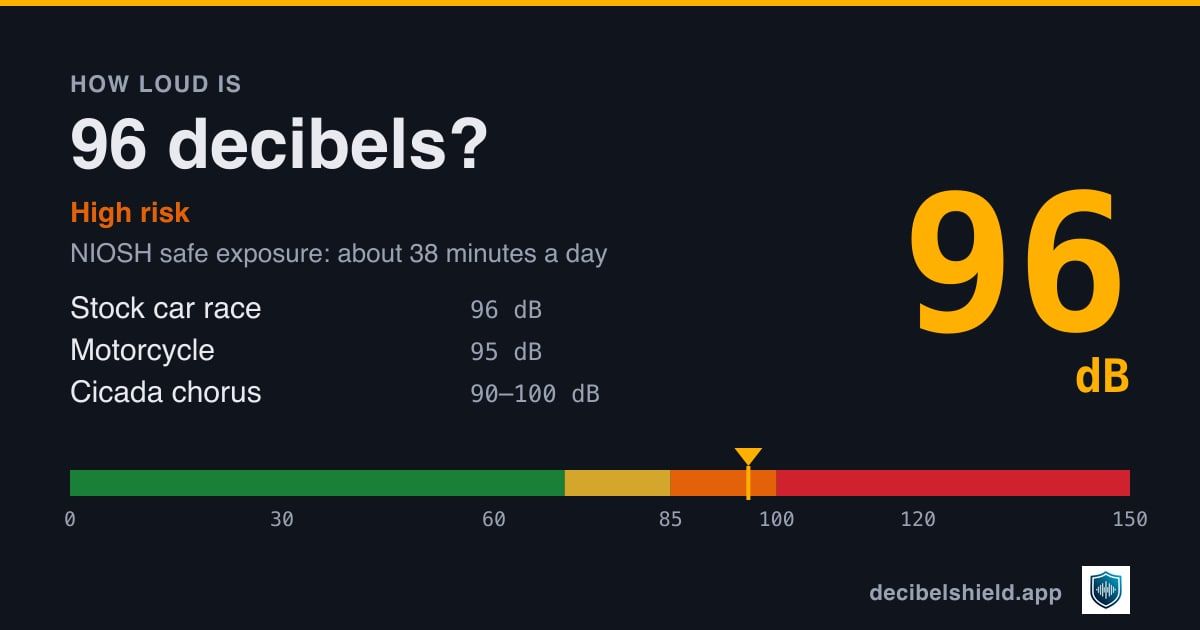
96 decibels is about as loud as a stock car race, a gas-powered leaf blower, a motorcycle. That is at or above the 85 dB hearing-risk line: NIOSH limits safe exposure to about 38 minutes a day, and every 3 dB louder halves that. On the decibel scale, each 10 dB step sounds roughly twice as loud. Measure it yourself with Decibel Shield's free online decibel meter.
Last updated:
| Sound level | 96 dB |
|---|---|
| Hearing risk | High |
| Safe exposure (NIOSH) | About 38 minutes a day |
| Workplace limit (OSHA) | 3 to 4 hours a day (OSHA noise limits) |
Measure 96 dB yourself
Want to know if where you are hits 96 dB? Press Start and the meter below reads it live. It runs in your browser, and nothing is recorded or uploaded.
What is comparable to 96 decibels?
Everyday examples of sounds around 96 decibels, each sourced to CDC, NIOSH, NIDCD and ASHA. Open any one for its own breakdown, or see the full decibel levels chart.
- Stock car race 96 dB
- Gas-powered leaf blower 92–102 dB
- Motorcycle 95 dB
- Cicada chorus 90–100 dB
- Barking dogs 88.4–100.3 dB
- Hand drill 98 dB
- Fuel-powered mower 86–97 dB
- Tractor with no cab 82–100 dB
- Circular saw 96–107 dB
- Sporting event 94–110 dB
- Movie theater 74–104 dB
- Train horn 96–110 dB
- Generator 79–97 dB
Is any city as loud as 96 dB?
No city averages 96 dB. That is a sound-source level, not an ambient one. The loudest mapped cities peak around 70–75 dB by day. These are the loudest mapped.
- Orange, CA 4.4% of residents at 70 dBA or more
- Terni 55–75 dB by day
- Hastings 55–75 dB by day
What does 96 decibels sound like?
96 decibels is about as loud as a stock car race, a gas-powered leaf blower, a motorcycle. That is at or above the 85 dB hearing-risk line: NIOSH limits safe exposure to about 38 minutes a day, and every 3 dB louder halves that. On the decibel scale, each 10 dB step sounds roughly twice as loud. Measure it yourself with Decibel Shield's free online decibel meter.
Is 96 decibels too loud?
Yes, 96 decibels is loud, about the loudness of a stock car race, at or above the 85 dB line, so prolonged exposure can damage hearing and ear protection is recommended.
How long is 96 decibels safe to hear?
At 96 dB, NIOSH puts the safe daily exposure at about 38 minutes a day. Each 3 dB increase halves it.
How far away can you hear 96 dB?
In open air a small source measured at 96 dB from 1 m falls to about 76 dB at 10 m and 56 dB at 100 m, losing 6 dB each time the distance doubles. You keep hearing it while it stays above the background level around you: farther in a quiet field at night, much less on a 60 dB street. Walls, ground and wind change the figure.
Work out any distance, or a line source such as a road, with the sound distance calculator.