 Decibel Shield
US cities › California › Oakland
Oakland noise map: where the city is loudest
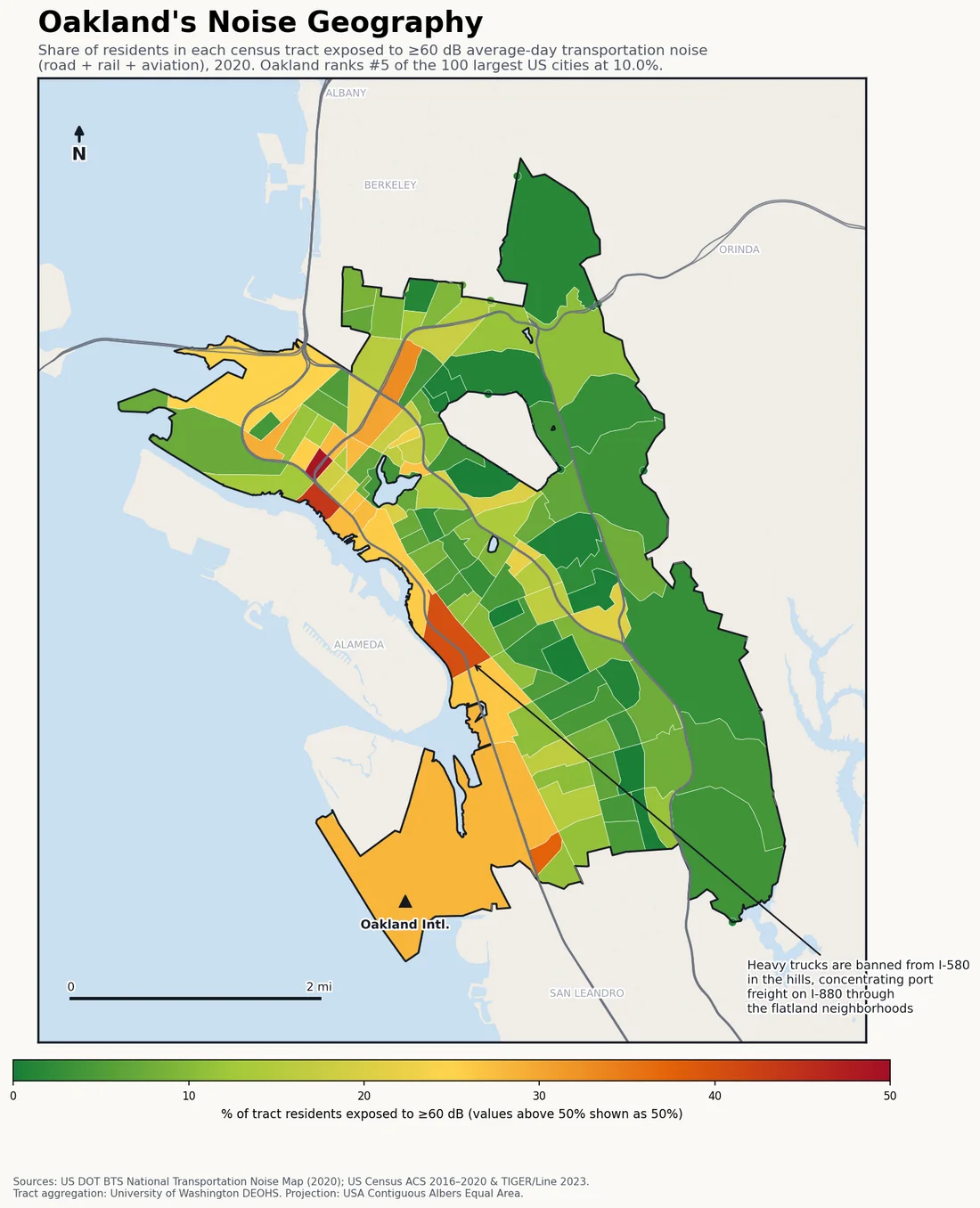
Oakland ranks 13th in the US, with 10% of residents above 60 dB and 3.6% above 70 dB. The red band hugs the flatlands along I-880, the Port of Oakland and the airport — while the hills above sit in green, one of the starkest noise-inequality gradients on any city map.
Last updated:
Find your street on the interactive map → Pan and zoom to your own block, type any US address, or use your location.
| US rank (of 297 cities, 100k+ pop) | #13 |
|---|---|
| Residents above 60 dB | 10% |
| Residents above 70 dB | 3.6% |
| Residents in the 45–60 dB band | 53.1% |
| Population (ACS 2016–2020) | 422,575 |
| Census tracts mapped | 116 |
Oakland’s map is really a map of its geography and its freight economy. The Port of Oakland is one of the busiest container ports in the country, and the trucks it generates run I-880 through the flatland neighborhoods of East and West Oakland. A long-standing truck ban on parallel I-580 through the hills pushes that heavy traffic onto 880 — a routing decision that environmental-justice researchers have documented for decades, and that the tract map renders in color.
Add Oakland International on the airport flats and the rail lines serving the port, and the city splits visibly in two: red and orange across the flatlands where freight, freeways and industry concentrate, green in the hill neighborhoods a few hundred feet above. Few city maps show the relationship between elevation, income and noise exposure this plainly.
Oakland noise: the specifics
- Heavy trucks are banned from parallel I-580 through the hills, concentrating port freight traffic on I-880 through flatland neighborhoods.
- The Port of Oakland is among the busiest container ports in the US, generating constant drayage truck traffic.
- 3.6% of residents live above 70 dB, almost entirely in the 880 corridor and airport flats.
- 10% of residents above 60 dB ranks #13 of 297 US cities — see the full federal ranking.
What share of Oakland residents are exposed to 60 dB or louder transportation noise?
10% of Oakland residents live with average-day transportation noise (road, rail and aviation) at or above 60 dB, and 3.6% are above 70 dB — ranking Oakland #13 of 297 US cities by noise exposure.
How Oakland ranks
- #10 of 66 California cities in-state
- Louder: Norwalk, CA #12
- Quieter: Honolulu, HI #14
Cities near Oakland
The nearest ranked cities to Oakland, each with its own share of residents above 60 dB for a like-for-like comparison.
- Berkeley, CA 6.8% ≥60 dB
- San Francisco, CA 9.5% ≥60 dB
- Hayward, CA 9% ≥60 dB
- Richmond, CA 11.1% ≥60 dB
How this map is made
This is a transparent aggregation of federal data, not an estimate: the BTS 2020 National Transportation Noise Map (road + rail + aviation) overlaid with Census ACS 2016–2020 population at tract level, clipped to the city boundary. Full methodology, limitations and the free CSV/JSON are on the US cities noise ranking. Remember what it doesn’t count: sirens, construction, nightlife and neighbors are outside the model.
License: this Oakland noise map and its underlying numbers are published under CC BY 4.0 — reuse or republish the map or the figures anywhere with attribution to decibelshield.app (source: BTS 2020 National Transportation Noise Map × Census ACS; basemap © OpenStreetMap contributors, © CARTO). Download the full dataset (CSV · JSON) or the full-resolution Oakland map image.
How loud is your block?
The map above shows averages by tract — your street is its own story. Measure it with the free online decibel meter → No install, nothing recorded.
Want to see the modeled road, rail and aircraft noise street by street? Open the interactive noise map zoomed to Oakland → Pan and zoom to your own neighborhood, type your address to check a specific spot, or use your location.
← All California cities · All 297 US cities ranked · World city sound map